
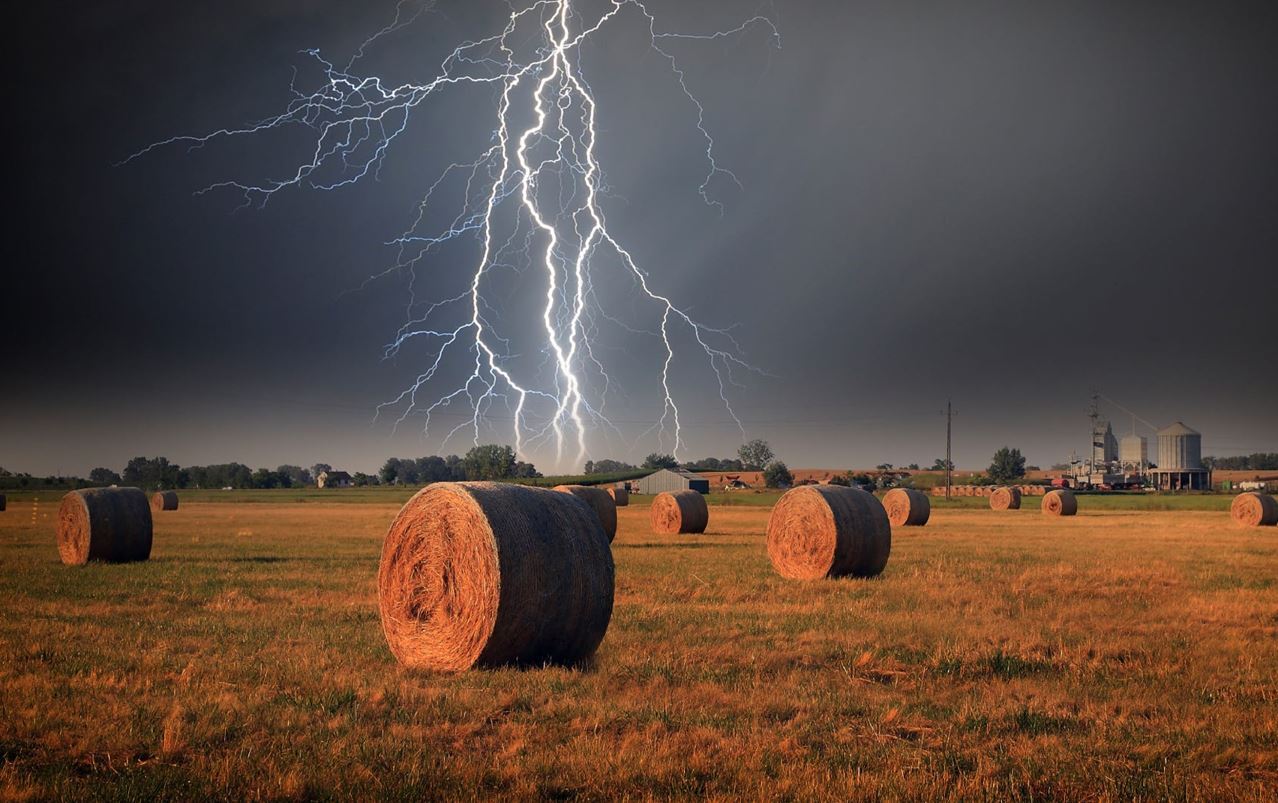
For more than a century, the world has relied on the Haber-Bosch and Ostwald processes to produce nitrogen fertilisers. Now there is a sustainable alternative: plasma-based nitrogen fixation. Using air and electricity for nitrogen fixation, followed by absorption of the plasma gas into water, the most direct route of nitric acid production is achieved. Combining this relatively simple and clean process with a scalable and flexible operation makes it suitable for revolutionising the nitrogen supply chain. .
Intermittent operation
Where the Haber-Bosch-Ostwald route is fundamentally built for scale, plasma-based nitrogen fixation is capex-friendly, flexible and scalable. Plasma-based systems are designed for flexibility. They do not need to operate 24/7 but can operate intermittently and be stopped and restarted quickly, which makes them well suited to variable renewable electricity.
Most direct pathway from air to green nitrates
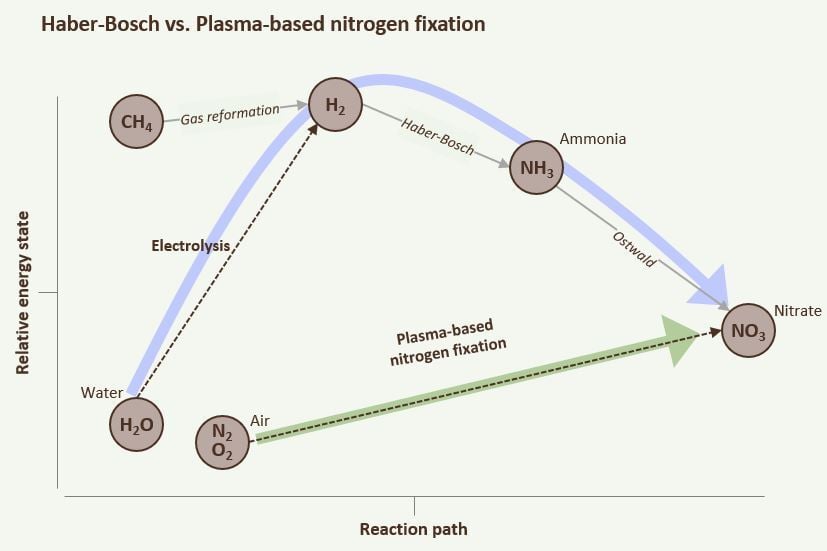
Nitrogen fixation using plasma technology provides the most direct pathway from air to nitric acid and nitrates. The plasma technology uses electricity to recombine the nitrogen and oxygen in air (containing 78% nitrogen as N2 and 21 % oxygen as O2), enabling the direct production of nitrogen oxides. These nitrogen oxides are subsequently absorbed into water to form nitric acid. And with nitric acid as a precursor, nitrate-based fertiliser products can be produced directly.
Produce where you use
The key difference compared to the Haber-Bosch-Ostwald route is not only the chemistry, but the industrial model. Because the plasma-based systems are modular, they can be deployed at both small and large scale. The “produce where you use” principle is a meaningful shift away from the centralised mega plants that dominate today’s nitrogen industry, to distributed local production using renewable electricity. Local production can reduce dependence on global supply chains and help shield end users from price volatility.
Low-carbon resilient production models
The Haber-Bosch-Ostwald chain will not disappear overnight. But the cracks in the model are becoming clearer: high CAPEX, large-scale risk, fossil dependence, emissions, and fragile logistics. Plasma nitrogen fixation offers a credible alternative pathway that is simpler, cleaner, and more aligned with the direction of the energy system. As renewables expand and industries seek lower-carbon, more resilient production models, direct electric production of nitric acid and nitrates is increasingly shifting from “future concept” to practical industrial option.
N2 Applied, a Norwegian technology company, is the pioneer in commercialising this approach through modular plasma systems that convert air, water and renewable electricity into nitric acid and nitrate-based fertiliser products.